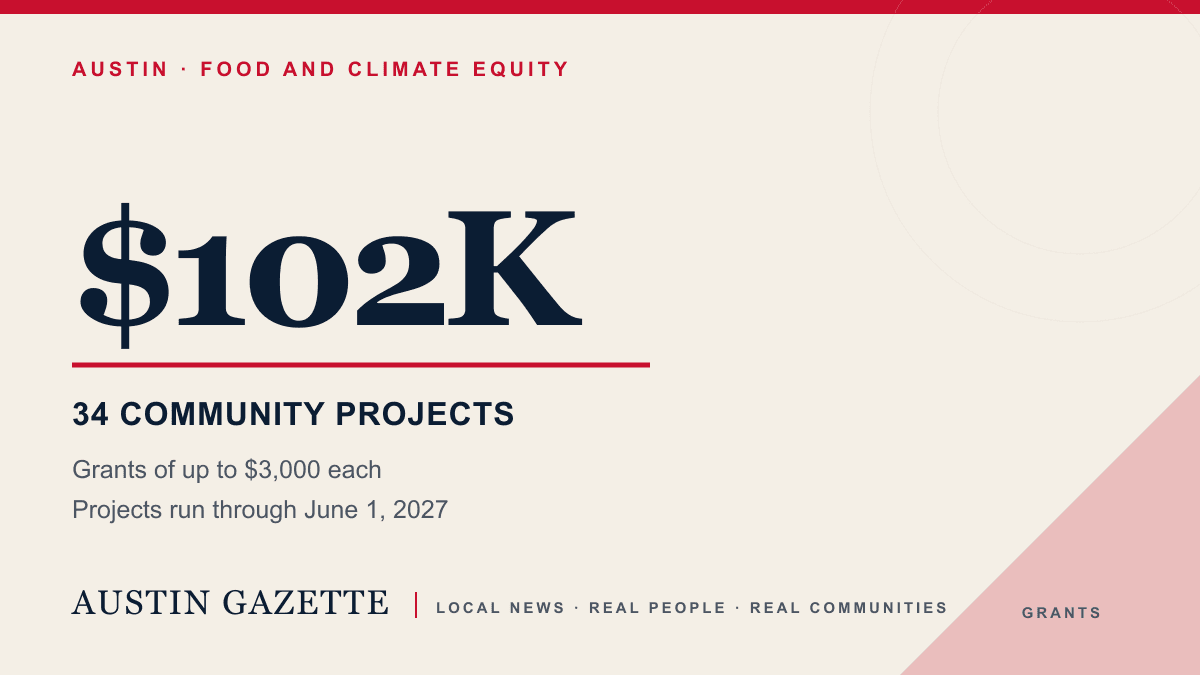
Austin's Office of Climate Action and Resilience has distributed $102,000 across 34 community-led projects through its Food and Climate Equity Grants program. Each organization received up to $3,000 to support work on local food systems, environmental inequalities, and community preparation for extreme weather events.
The funded projects span diverse approaches to community strengthening. Examples include a health clinic establishing a community garden to improve access to nutritious food, community organizers providing emergency preparedness training as extreme weather becomes more frequent, and educators expanding Green Teams that enable students to lead sustainability initiatives in Austin schools.
Zach Baumer, director of Austin's Office of Climate Action and Resilience, stated that community-led projects are essential to the city's climate, resilience, and food systems objectives. He noted the diversity of supported projects this year and anticipated measurable community benefits.
The program prioritizes projects addressing systemic and structural inequities, with emphasis on historically marginalized communities. The city aims to create a more equitable and resilient future through this funding approach.
Nyeka Arnold, founder and executive director of The Healing Project, described food justice as ensuring neighbors can access healthy food and essential resources with dignity regardless of transportation barriers, mobility limitations, income, or other obstacles. She characterized the grant as strengthening community health and resilience while supporting long-term generational health across Austin.
At Austin Independent School District, the grant funding will increase accessibility for the second year of the Green Team Leaders Accelerator Program. Carsen Daniel, the district's sustainability coordinator, explained that educator investment through this program builds lasting capacity for resilient, healthy schools while preparing students to become informed environmental advocates and civic leaders.
Organizations receiving funding include the Del Valle Community Coalition Non-profit, Far East Austin Community Development Corporation, Interfaith Action of Central Texas, Partners for Education Agriculture and Sustainability, People Organized in Defense of Earth and her Resources, and Rebuilding Broken Communities/St. John Faith Community Garden, among others.
Grant recipients have until June 1, 2027, to complete their projects. Additional information is available through the city's climate office website.
Austin's Office of Climate Action and Resilience focuses on creating a thriving, equitable, and resilient community through leadership and measurable benefits. The office coordinates citywide efforts toward net-zero greenhouse gas emissions by 2040, development of a healthy and just local food system, protection and expansion of urban forest, and strengthened climate resilience.
Source: This report is based on information published by City of Austin.