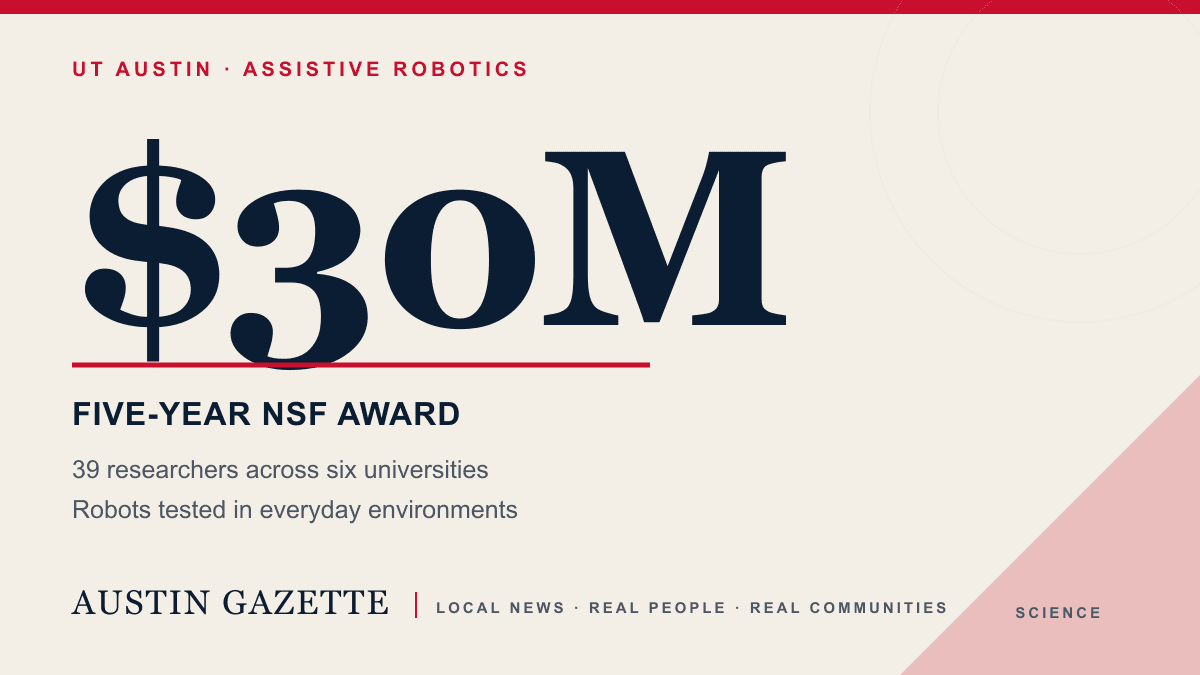
The University of Texas at Austin will lead a new $30 million research center examining how assistive robots and people learn to adapt to one another in homes, hospitals and other everyday settings.
The five-year National Science Foundation award will establish the Center for Human and Robot Co-Adaptation. UT says the project will bring together 39 researchers from six universities as well as a group of technology and robotics companies.
Joydeep Biswas, an associate professor of computer science at UT Austin, will direct the center. Its work will look beyond whether a robot can complete a single programmed task and instead study how people and machines change their behaviour over months or years of living and working together.
Robots will be studied outside the laboratory
The research will use real-world deployment sites including houses, dormitories, cafés, a museum, a rehabilitation hospital and assisted-living residences.
One example described by UT is an assistive robot learning to adjust its reach to match a person's physical limitations. The wider goal is to understand how a system can respond as a person's needs, routines and surroundings change.
Researchers will also use simulations and digital versions of the test locations before deploying new ideas in physical spaces. UT's Texas Advanced Computing Center is expected to provide computing, machine-learning and data-storage support.
Six universities and industry partners
Alongside UT Austin, the university partners are MIT, Yale University, Indiana University Bloomington, the University of Utah and Tufts University.
Industry collaborators named by UT include Amazon, Apptronik, Diligent Robotics, Google DeepMind, Hello Robot, MassRobotics, NVIDIA and Robust AI. Their involvement is intended to connect academic work with current robotics hardware and computing platforms.
The center will have an internal ethics board. UT says community members at deployment sites will be able to influence when and how robots are introduced, while the research will include consent and opt-out procedures.
The project also plans to produce open-source robotics and artificial-intelligence teaching materials, expand undergraduate research and work with high-school teachers on a robotics education programme.
Further information about the partners, research settings and education plans is available in UT Austin's official announcement. Austin Gazette has used an original information graphic rather than reproducing the university's photographs.