The University of Texas at Austin has launched a new funding initiative designed to accelerate fusion energy research while building a skilled workforce for private companies entering the field.
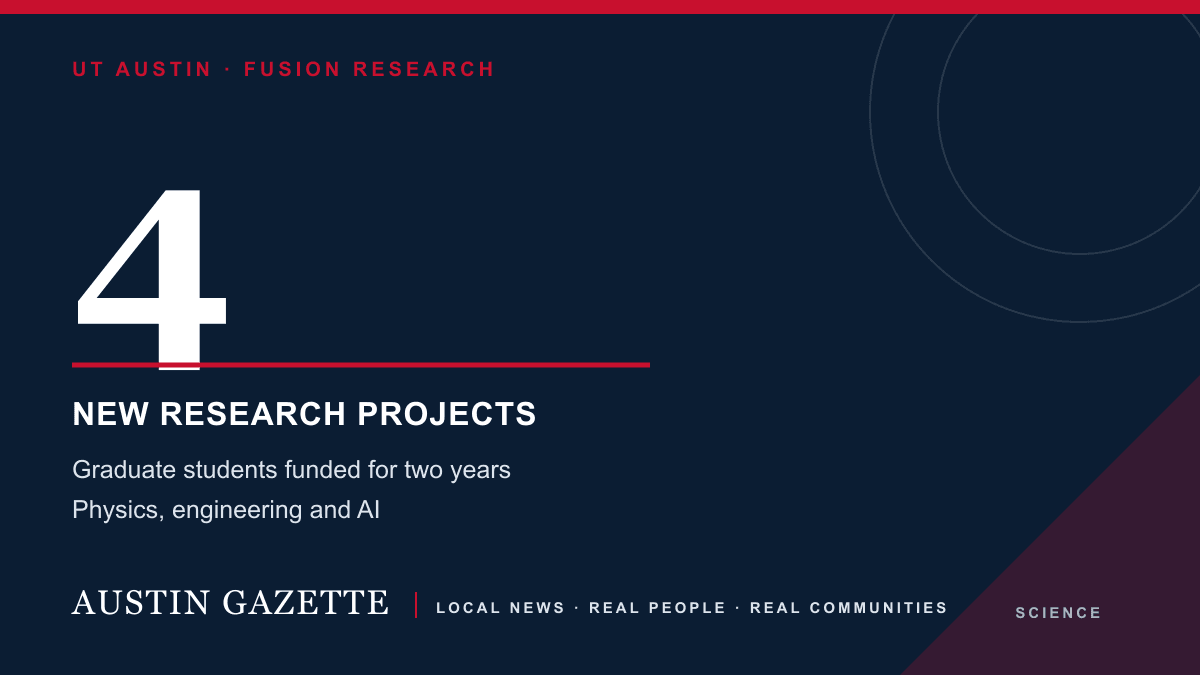
Diego del-Castillo-Negrete, director of UT Austin's Institute for Fusion Studies, created the seed grant program to connect researchers across three university units: the Institute for Fusion Studies, the Oden Institute and the Cockrell School of Engineering. Four grants were recently awarded, each supporting graduate students for two years.
The timing reflects momentum in fusion energy. Since Lawrence Livermore National Laboratory achieved fusion ignition three and a half years ago, the field has attracted significant attention and investment. The new collaborations aim to position UT Austin as a leader in this emerging industry.
Four Research Projects
Each funded project pairs physicists from the Institute for Fusion Studies with engineering or computational experts. Three of the four projects focus on replacing slow, computationally expensive simulations with faster artificial intelligence models trained on existing data.
One project addresses plasma instability inside tokamak reactors. Researchers plan to create a digital representation of plasma based on limited measurements, then use it to automatically adjust magnetic coils in real time. The team hopes to eventually test their system at working reactors in Switzerland and California.
A second project explores liquid metal alloys as protective materials for reactor walls. High-energy particles and heat can damage reactor components, so researchers are designing alloys that could be continuously recycled. Candidate materials identified through computer simulation could be tested at facilities in Pennsylvania and at Princeton University.
Two additional projects aim to speed up design processes. One focuses on tracking high-energy particles escaping from reactors, potentially making calculations 10 to 100 times faster than current methods. The other addresses the complex simulation of material layers at reactor edges.
Workforce Development Focus
University officials emphasized that the program addresses a critical need. Private fusion companies face challenges finding enough skilled workers to overcome technical obstacles in commercializing fusion energy.
Del-Castillo-Negrete stated that successful completion would lead graduate students to pursue doctoral degrees in fusion research, publish scientific papers and gain experience applicable to industry or academic careers.
Josh Burby, an assistant professor of physics involved in one project, noted that structured collaboration can overcome typical barriers between busy faculty members while creating mutual benefits.
Alignment With National Priorities
The projects align with the U.S. Department of Energy's emphasis on artificial intelligence applications in fusion research. By developing faster computational methods, researchers aim to make fusion technology more accessible to private companies and accelerate the path from laboratory experiments to commercial deployment.
Del-Castillo-Negrete emphasized that combining physics-based optimization with machine learning techniques creates capabilities neither discipline could achieve alone, positioning UT Austin's work to potentially influence how fusion reactors are designed and controlled.
Source: This report is based on information published by The University of Texas at Austin.