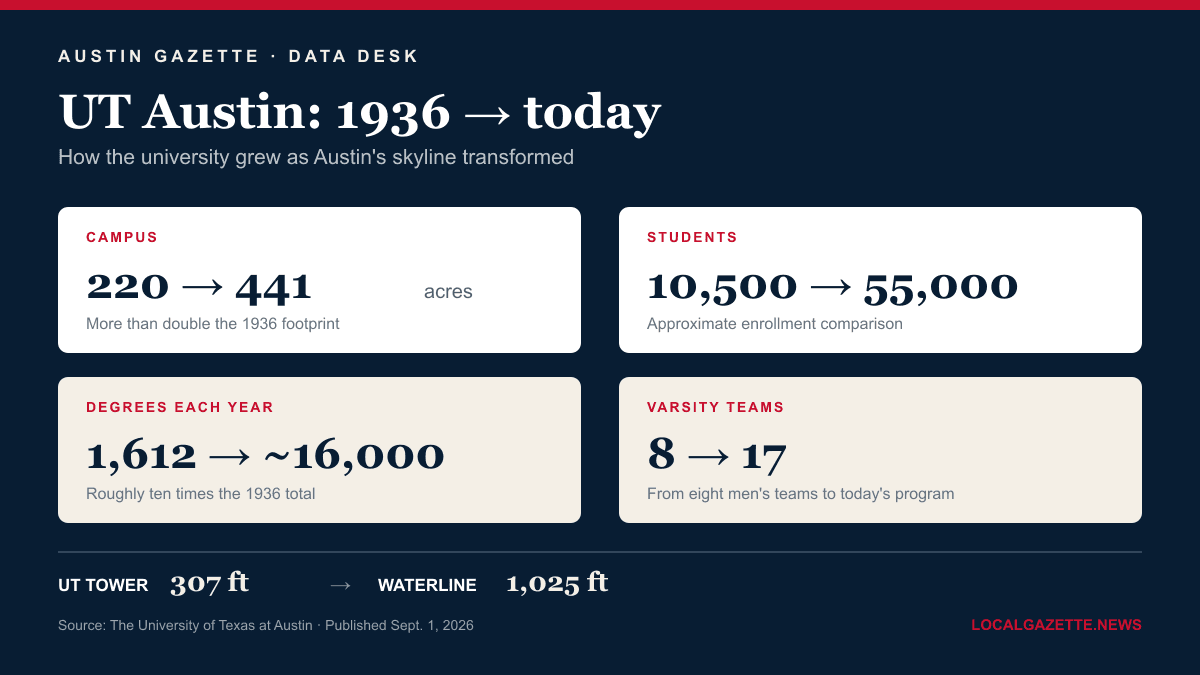
The University of Texas at Austin has more than doubled the size of its main campus and now enrolls more than five times as many students as it did when the UT Tower opened in 1936.
A historical comparison released by the university shows how the campus and the city around it have changed over the past 90 years. UT's figures put the main campus at 220 acres in 1936 and 441 acres today. Student numbers have risen from about 10,500 to roughly 55,000, while annual degrees have increased from 1,612 to about 16,000.
UT Austin in 1936 and today
- Campus: 220 acres in 1936; 441 acres today
- Students: about 10,500; roughly 55,000 today
- Degrees: 1,612 awarded in 1936; about 16,000 each year today
- Varsity teams: eight men's teams in 1936; 17 teams today
The Tower no longer defines Austin's height
At 307 feet, the UT Tower was Austin's tallest building when it was completed. The Texas Capitol, then the city's other dominant landmark, stands 302.64 feet tall. That position changed as Austin's commercial skyline grew: construction began on the American Bank Building in 1972, and the new building rose six feet higher than the Tower.
The contrast is much greater today. UT says the Tower is now the 55th-tallest building in Austin. Waterline, the city's tallest building, reaches 1,025 feet — more than three times the Tower's height.
Campus and city grew together
Austin itself grew from about 60,000 residents in the mid-1930s to around one million. The university expanded with it, adding academic buildings, housing, research space and larger venues.
Gregory Gym opened in 1930 with capacity for 4,000 people. Moody Center, which opened in 2022, can hold about 15,000. By 1937, Texas Memorial Stadium had 40,500 seats; today's Darrell K Royal-Texas Memorial Stadium holds 100,119.
A broader athletics program
UT fielded eight varsity teams in 1936, all for men. Women's varsity basketball and volleyball were introduced in 1966, and the university now supports 17 varsity teams. Across those programs, Texas has won 72 national championships.
The figures accompany UT's continuing focus on the Tower itself. University President Jim Davis identified restoration of the landmark as one of five priorities in his inaugural address last year.
Readers can examine the university's full historical comparison in UT Then and Now, published by The University of Texas at Austin on September 1, 2026.